We advance molecular analysis and biological modelling to make deeper biological insight more accessible. Our research connects clinical evidence, analytical innovation, systems biology and AI.
Blood carries many kinds of information. Metabolomics, lipidomics and proteomics reveal complementary layers of that picture.
The depth of multi-omics.
01SMALL MOLECULES
Glucose · Glycerol
Metabolomics
What metabolism uses and makes.
Metabolites are small molecules used or produced by the body. Their patterns in blood provide clues to mitochondrial energy metabolism, amino acid pathways and oxidative balance, as well as responses to nutrition and activity. Read together, they reveal connections that isolated measurements cannot capture.
02LIPID DIVERSITY
Cholesterol · Linolenic acid
Lipidomics
More than a total fat level.
Lipids include cholesterol, fatty acids and many other molecules. They store energy, build cell membranes and carry signals. Lipidomics measures their diversity in blood, beyond a total cholesterol or triglyceride level.
03PROTEIN STRUCTURES
Ubiquitin · PDB 1UBQ
Proteomics
The proteins at work.
Proteins transport substances, support immune defence and drive chemical reactions. Proteomics identifies and measures proteins in blood, providing information about biological processes across tissues and organs.
02 / SYSTEMS BIOLOGY & AI
Advancing systems biology.
Biology works through connections.
A blood test often compares each result with a range seen in a reference population. That comparison is useful, but it cannot, on its own, explain how biological processes work together or how one person is changing over time.
Systems biology studies those connections: how molecules, cells and organs influence one another. We connect molecular measurements with biological knowledge and repeated observations to model these relationships at the individual level.
We combine established biological knowledge with specialised computational models to investigate how biological systems connect and interact.
Our research brings together knowledge graphs, bioinformatics and AI. Each twin update recalculates relationships and scores in the context of the individual.
2,500metabolic pathways
8 billionTwin Data Points
We bring molecular measurements, clinical results and everyday context together to build an evolving biological signature.
Four examples from 2,500 metabolic pathways
01 / 04
Established evidence informs our approach. Research extends how we model individual responses.
Food compounds
We use established evidence on nutrients and food composition to inform nutrition insights, and develop models of how food compounds interact with individual pathways.
ILLUSTRATIVE NETWORK DETAIL
Preparing interactive portrait
Illustrative network
03 / LONGITUDINAL RESEARCH · N-OF-1
Biological signatures. Tracked over time.
Our N-of-1 research approach connects repeated measurements and interventions to refine each individual’s biological twin.
An evolvingbiological signature
01 / 05Explore the loop →
ESTABLISH A STARTING POINT
Read the biology. Keep the context.
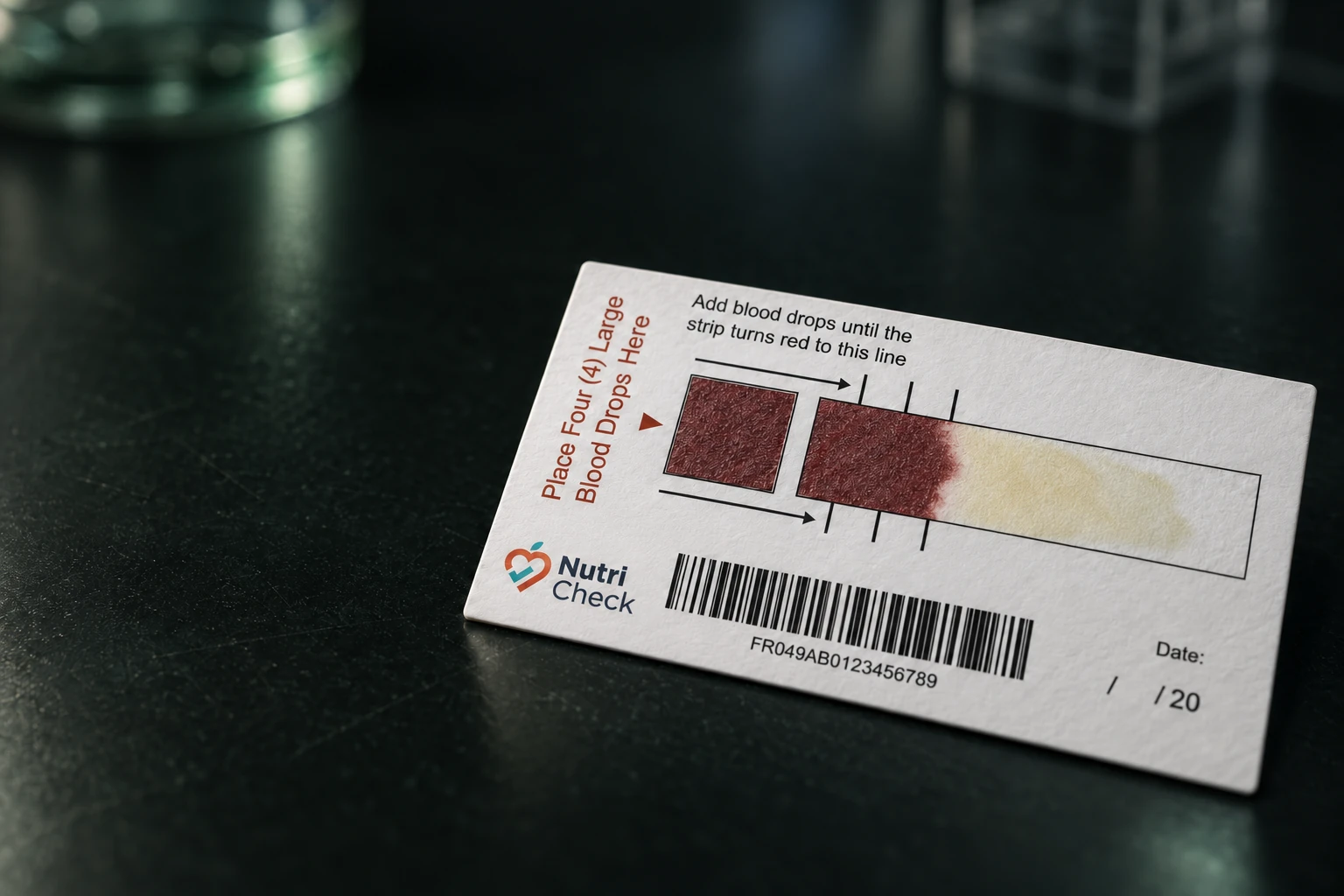
Molecular signals from small plasma-separation samples establish an individual starting point, alongside clinical results and everyday context.
Sample 01
Sample 02
Same individual · Illustrative signals
GROUNDED IN SCIENCE
A world of knowledge. Connected to biology.
Scientific evidence, biological knowledge and specialised tools. Connected to inform health insights and enrich the twin.
✧
Evidence, brought into context.
Peer-reviewed literature and our curated corpus inform personalised health information and Health Reels, with evidence assessed for strength and relevance.
OUR RESEARCH PROGRAMME
Help make molecular analysis more accessible.
NutriCheck is a mission-driven deep tech company.
We develop analytical methods to identify molecular signals more reliably and reduce the cost of molecular analysis.
Contributing samples helps advance this research and make deeper analysis accessible to more people.
Join us in analytical science, systems biology, bioinformatics, artificial intelligence, world models, and biological and longitudinal modelling. Together, we can evaluate methods, examine reproducibility and develop publishable evidence.